
Meet the Grumman F-14A Tomcat
US Navy BUNO - 161134
History
Grumman F-14A Tomcat – BuNo 161134
Few aircraft are as instantly recognizable as the Grumman F-14 Tomcat, and the example preserved at the Valiant Air Command Warbird Museum has a remarkable history of its own.
The museum's aircraft, F-14A Tomcat Bureau Number 161134, was constructed by Grumman as an F-14A-110-GR, construction number 361, and entered United States Navy service in 1980. During its career it became TARPS-capable, allowing the Tomcat to carry the Tactical Airborne Reconnaissance Pod System and perform high-speed photographic reconnaissance missions in addition to its traditional fleet-defense role.
From Fighter to Reconnaissance Aircraft
The F-14 had originally been designed primarily to protect the Navy's aircraft-carrier battle groups. Its powerful AWG-9 radar, long-range AIM-54 Phoenix missile capability and variable-sweep wings made it one of the most formidable naval fighters of its generation.
However, the Tomcat also became an extremely valuable reconnaissance platform. Equipped with TARPS, an F-14 could photograph targets while operating at high speed and at considerable distance from the carrier.
This capability would give 161134 one of the most interesting chapters of its career.
VF-103 “Sluggers” and the Achille Lauro Crisis
By 1985, 161134 was assigned to Fighter Squadron 103 (VF-103) “Sluggers”, carrying the modex 214.
In October that year, the hijacking of the Italian cruise ship Achille Lauro triggered an international crisis. After the hijackers left the ship, they boarded an EgyptAir Boeing 737 intending to fly from Egypt to Tunisia.
U.S. Navy F-14s intercepted the airliner over the Mediterranean and compelled it to land at the NATO airfield at Sigonella, Sicily, where an extraordinary confrontation subsequently developed between American and Italian forces over custody of the hijackers.
BuNo 161134, operating as CLUBLEAF 214, played a direct reconnaissance role in the operation. Its TARPS system was used to obtain imagery of the situation on the ground at Sigonella, documenting the confrontation surrounding the aircraft.
This gives 161134 a direct connection to one of the most unusual episodes in U.S. naval aviation and counterterrorism history.
The Grim Reapers
Following its service with VF-103, 161134 returned to VF-101 “Grim Reapers”, the Navy's East Coast F-14 Fleet Replacement Squadron.
VF-101 was responsible for training the pilots, Radar Intercept Officers and maintenance personnel who would operate the Tomcat throughout the Atlantic Fleet. As a result, aircraft assigned to the squadron played an important role in preparing generations of naval aviators for operational F-14 service.
VF-84 “Jolly Rogers”
In 1987, 161134 joined one of the most famous fighter squadrons in United States Navy history: VF-84 “Jolly Rogers.”
With its unmistakable skull-and-crossbones tail markings, VF-84 became perhaps the most visually recognizable of all F-14 squadrons.
During its time with the Jolly Rogers, 161134 carried the markings AJ-211 and operated with Carrier Air Wing Eight. The aircraft is documented wearing those markings while assigned to USS Theodore Roosevelt (CVN-71), including during the ship's early years of carrier operations. Photographs also record 161134 as AJ-211 during a visit to Britain in 1988.
VF-41 “Black Aces”
Later in its career, 161134 was assigned to another historic Tomcat squadron, VF-41 “Black Aces.”
VF-41 had a distinguished association with the F-14. In August 1981, aircraft from the squadron achieved the first air-to-air victories by U.S. Navy F-14s, shooting down two Libyan Su-22s over the Gulf of Sidra.
During the 1990s the squadron's mission expanded as the Tomcat developed from a primarily air-to-air fighter into a true multi-role combat aircraft. VF-41 also assumed a TARPS reconnaissance role following the disestablishment of VF-84 in 1995. The Black Aces later became the first Tomcat squadron to employ air-to-ground ordnance against enemy targets during Operation Deliberate Force over Bosnia-Herzegovina.
The End of an Extraordinary Flying Career
By the end of 1997, the Navy was gradually reducing the number of early F-14A aircraft in service as newer Tomcats and eventually the F/A-18E/F Super Hornet began assuming their missions.
Rather than being sent to storage or destroyed, 161134 was selected for preservation.
On November 19, 1997, the Tomcat made its final flight from Naval Air Station Oceana, Virginia, to Titusville, Florida, beginning the next chapter of its life as a museum aircraft. Contemporary museum information records this as the aircraft's final flight.
During its Navy career, records associated with the aircraft credit 161134 with an impressive:
-
5,792 flight hours
-
1,389 catapult launches
-
1,407 arrested carrier landings
These numbers illustrate the demanding life of a carrier-based fighter. Every catapult launch subjected the aircraft to tremendous acceleration, while every arrested landing brought the Tomcat from flying speed to a complete stop in only a few seconds.
Preserved at Valiant Air Command
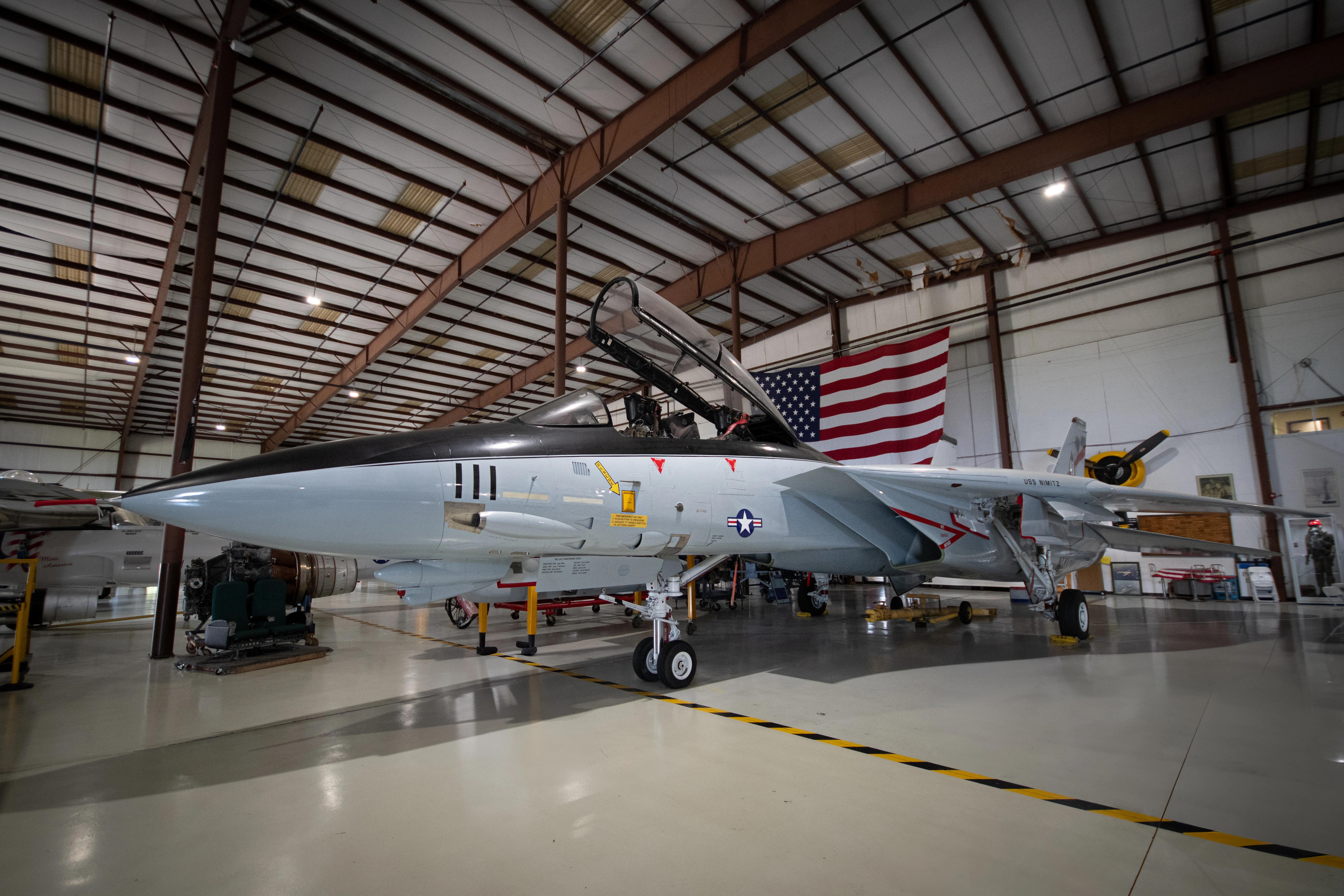
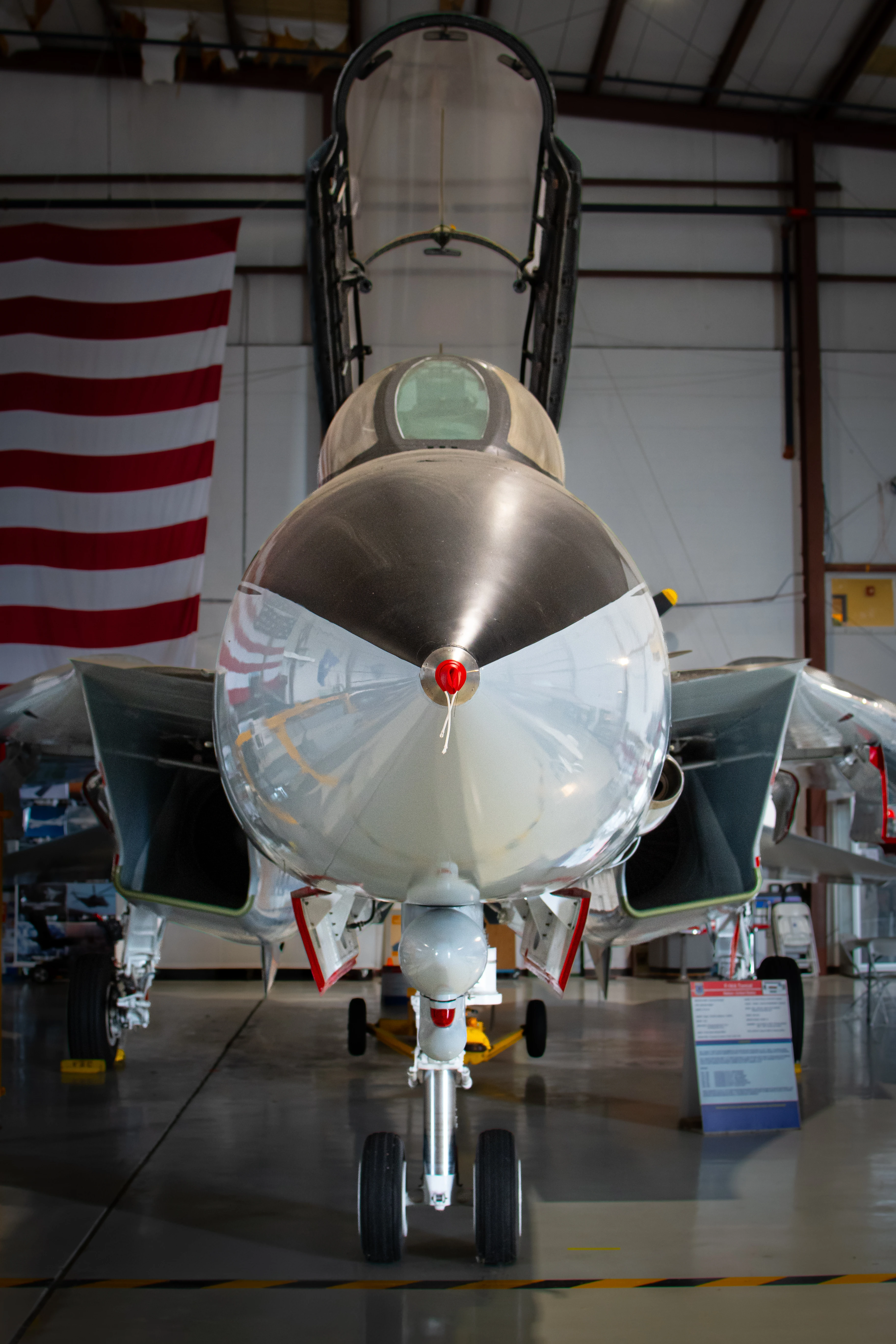
Today, F-14A BuNo 161134 is preserved at the Valiant Air Command Warbird Museum in Titusville, Florida, on loan from the National Naval Aviation Museum collection.
The aircraft is displayed in the markings of VF-41 “Black Aces,” AJ-114, representing one of the squadrons with which it actually served.
Unlike many preserved combat aircraft whose histories have been lost or separated from the airframe, 161134 retains a particularly rich documented story. It served with some of the Navy's most famous Tomcat squadrons, performed the demanding carrier operations for which the F-14 was designed and carried the TARPS reconnaissance system on historically significant missions.
From the decks of U.S. Navy aircraft carriers to the confrontation at Sigonella, and ultimately to its retirement in Titusville, BuNo 161134 is much more than an example of the legendary F-14 Tomcat — it is a surviving piece of United States Naval Aviation history.
TLDR; A supersonic Hollywood Icon
F-14A Tomcat BuNo 161134 entered U.S. Navy service in 1980 and served with several notable squadrons, including VF-103 “Sluggers,” VF-101 “Grim Reapers,” VF-84 “Jolly Rogers,” and VF-41 “Black Aces.” TARPS-capable, it took part in reconnaissance operations during the 1985 Achille Lauro hijacking crisis, photographing the situation at Sigonella, Sicily. It later served aboard U.S. Navy aircraft carriers before making its final flight to Titusville on November 19, 1997. During its career, 161134 accumulated 5,792 flight hours, 1,389 catapult launches, and 1,407 arrested landings. Today, it is preserved at the Valiant Air Command Warbird Museum in VF-41 “Black Aces” markings.
Gallery


“This aircraft on loan from the National Naval Aviation Museum on behalf of the Navy History and Heritage Command”