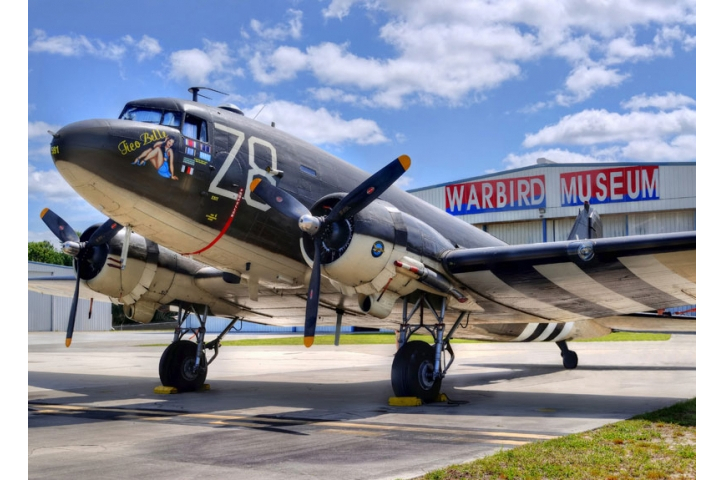
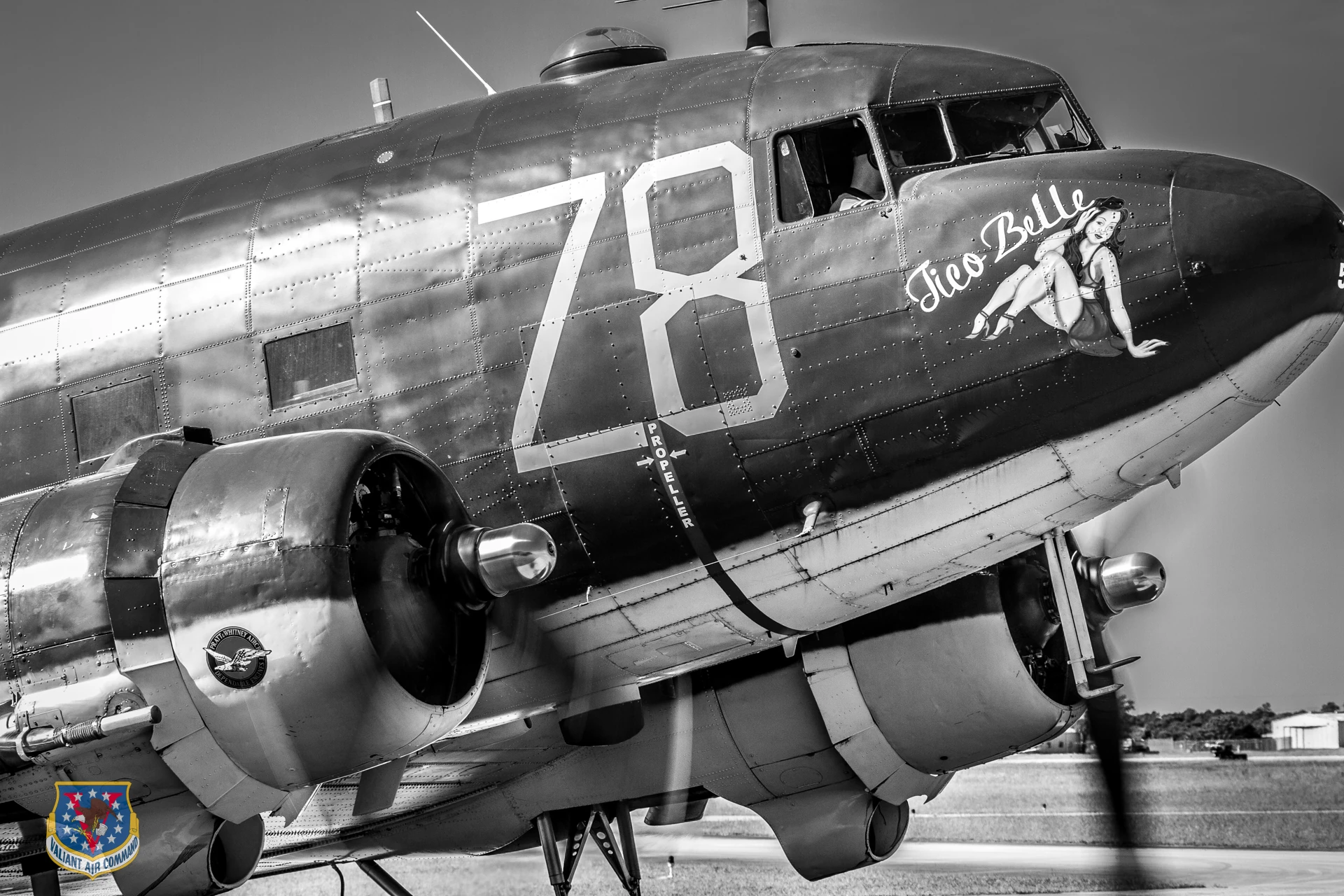
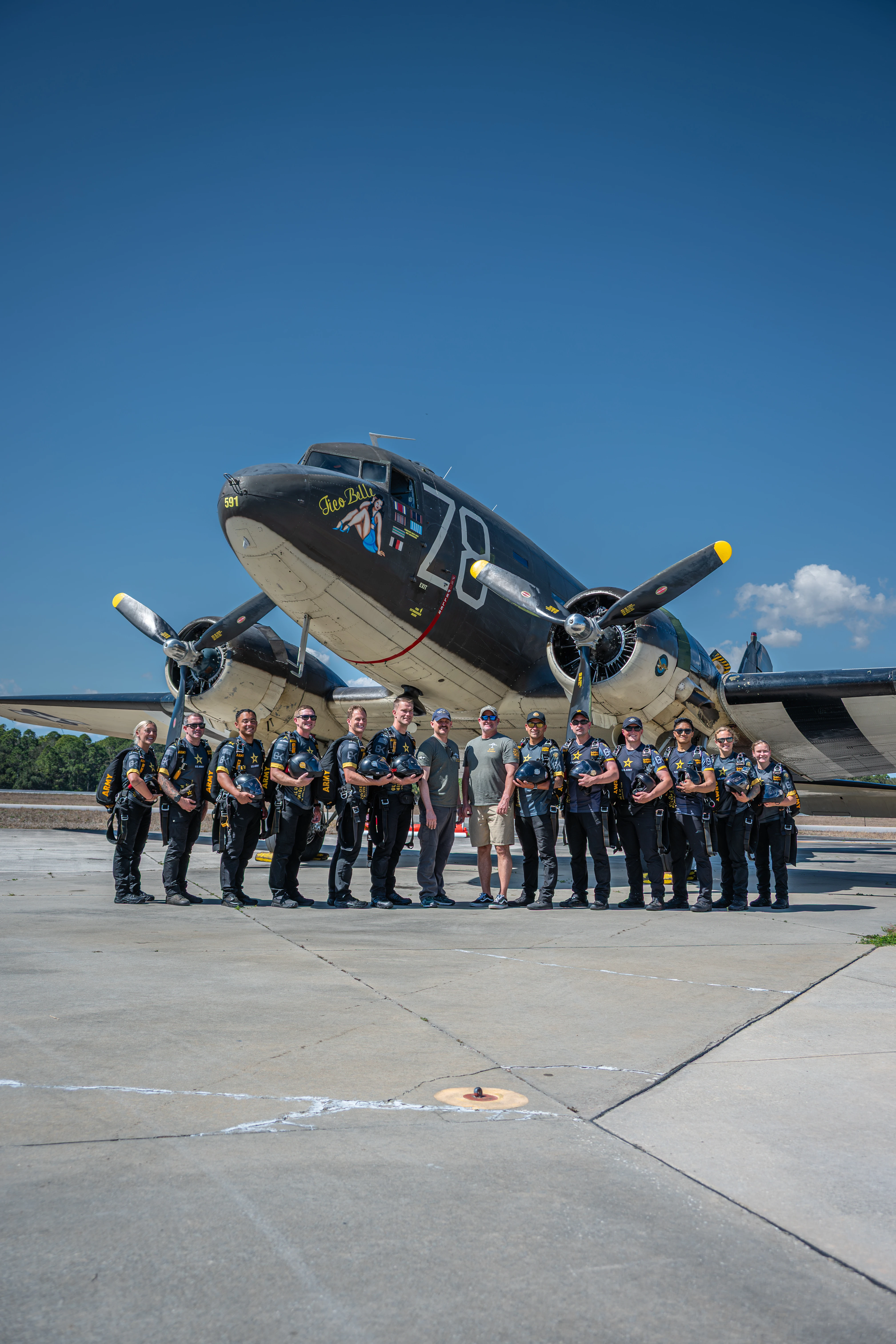
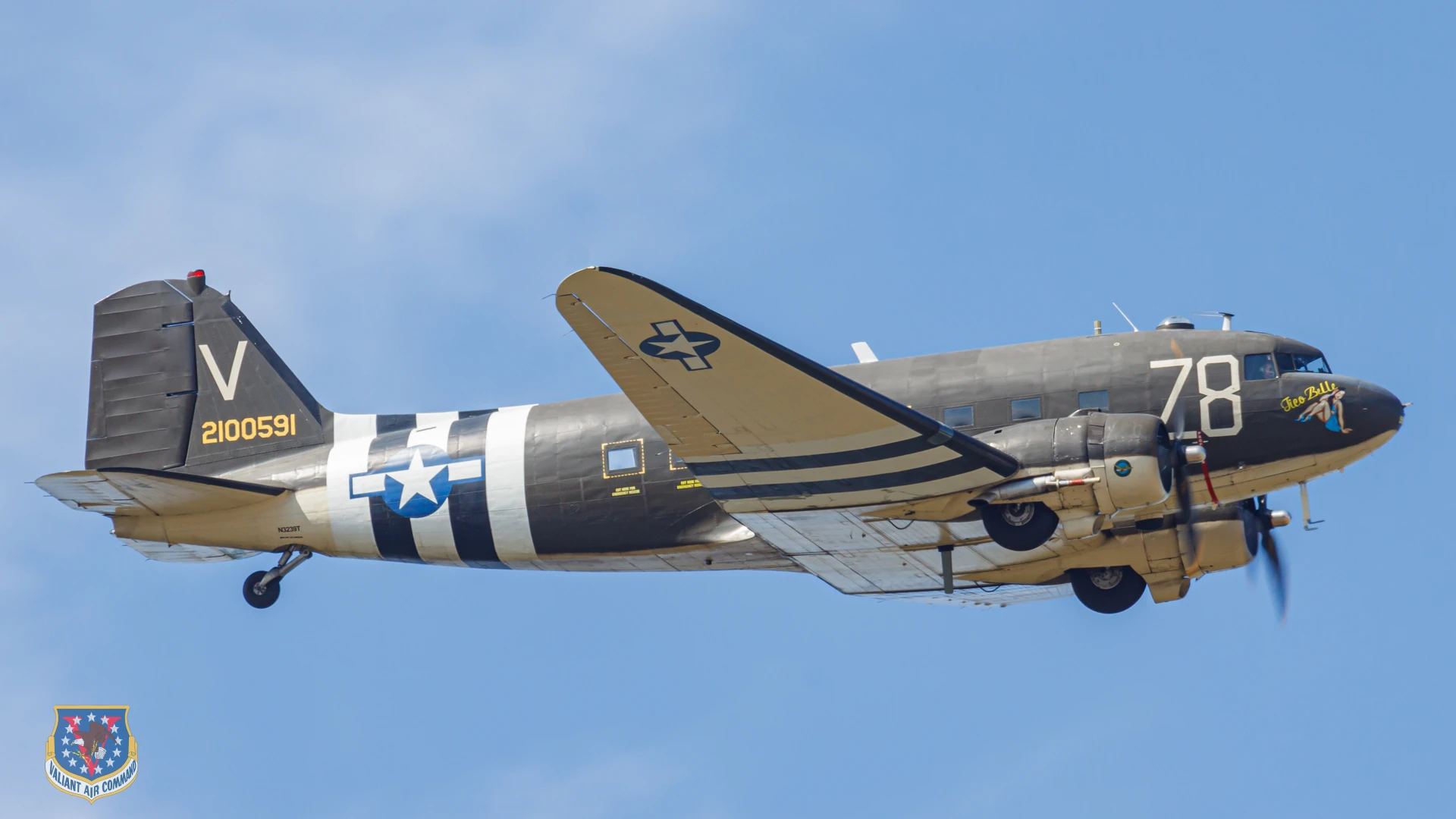
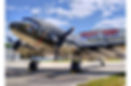
Meet the DOUGLAS C-47A SKYTRAIN “TICO BELLE”
USAAF SERIAL 42-100591 / N3239T
History
FROM LONG BEACH TO WAR
The Douglas C-47A that is today known as Tico Belle was manufactured by Douglas Aircraft Company at Long Beach, California, as construction number 19054. Assigned U.S. Army Air Forces serial number 42-100591, she was delivered to the USAAF in November 1943.
In early 1944 the aircraft crossed the Atlantic to England, where she joined the 84th Troop Carrier Squadron, 437th Troop Carrier Group, under IX Troop Carrier Command of the Ninth Air Force.
The 437th Troop Carrier Group was based at RAF Ramsbury in Wiltshire, England. Aircraft of the 84th Troop Carrier Squadron carried the squadron code Z8, and 42-100591 carried the individual aircraft letter V, giving her the wartime identification Z8-V.
The 437th had deployed to England specifically to prepare for the invasion of occupied Europe. Its crews trained intensively in formation flying, airborne operations, supply missions and the towing of troop-carrying gliders.
D-Day - Mission Detroit
In the early hours of June 6, 1944, 42-100591 departed RAF Ramsbury as part of the 437th Troop Carrier Group’s first combat operation.
She flew as Chalk 50 in Serial 28 during Mission Detroit.
Rather than carrying paratroopers inside the C-47, 42-100591 was towing a Waco CG-4A glider carrying personnel and equipment of the U.S. Army’s 82nd Airborne Division.
Mission Detroit delivered glider-borne troops, vehicles, anti-tank weapons and other equipment to the Sainte-Mère-Église area of Normandy in support of the airborne forces that had landed earlier that morning.
The recorded crew of 42-100591 consisted of:
1st Lt. Jay E. Bloch — Pilot
2nd Lt. Oscar B. Hill — Co-pilot
S/Sgt. John A. Quinn — Crew Chief
Pfc. J. D. Calhoun — Radio Operator
Flying through darkness, poor visibility and German anti-aircraft fire, 42-100591 successfully completed her glider-towing mission over Normandy.
Tico Belle is therefore not simply a surviving C-47 from the Second World War; she is a genuine D-Day combat veteran and glider tug.
D-Day - Mission Galveston
The aircraft’s work over Normandy did not end on June 6.
On June 7, 1944, 42-100591 again departed Ramsbury and once more flew as Chalk 50, this time as part of Serial 34 during Mission Galveston.
She again towed a troop glider into Normandy, helping deliver additional personnel, artillery and equipment to the 82nd Airborne Division.
The 437th Troop Carrier Group received a Distinguished Unit Citation for its actions in support of the Normandy invasion.
In the weeks following D-Day, the group continued flying supply, reinforcement and evacuation missions as Allied forces expanded the Normandy beachhead and advanced across France.
Operation DRAGOON — Southern France
In the summer of 1944, elements of the 437th Troop Carrier Group moved south in preparation for Operation Dragoon, the Allied invasion of southern France.
The invasion began on August 15, 1944.
Troop carrier aircraft delivered airborne forces into southern France and subsequently flew reinforcement and resupply missions in support of the invasion.
42-100591 is recorded as having participated in the Southern France campaign before the 437th returned to England later that month.
Operation MARKET GARDEN
Only weeks later, the 437th Troop Carrier Group was committed to another of the Second World War’s major airborne operations.
During Operation Market Garden in September 1944, the group’s C-47s again carried and towed airborne forces into combat, this time over the Netherlands.
The operation was intended to secure a chain of bridges through the Netherlands and establish an Allied route across the Rhine into Germany.
42-100591 is recorded as having participated in the operation, continuing an extraordinary sequence of major European airborne campaigns.
BASTOGNE AND THE BATTLE OF THE BULGE
In December 1944, the German offensive through the Ardennes created an urgent need for Allied transport aircraft.
American forces at Bastogne became surrounded, and C-47 crews flew desperately needed ammunition, food, medical supplies and other equipment to the besieged troops.
42-100591 is credited with participating in the resupply operations associated with Bastogne during the Battle of the Bulge.
For aircraft such as 42-100591, troop-carrying and glider-towing missions were only part of their wartime duties. Between major airborne operations, C-47s transported ammunition, fuel, food, and personnel while also evacuating wounded servicemen from forward areas.
Operation VARSITY — Across The Rhine
By March 1945, Allied forces had reached the Rhine.
On March 24, 1945, Operation Varsity launched one of the largest single-day airborne operations of the war.
The 437th Troop Carrier Group participated in the assault near Wesel, Germany, with its aircraft towing troop gliders across the Rhine under intense German anti-aircraft fire.
42-100591 is recorded as participating in Operation Varsity and towing two gliders loaded with airborne troops.
Within weeks, the war in Europe was over.
Post-War Service and the Berlin Airlift
After the end of World War II, 42-100591 remained in military service.
Historical accounts of the aircraft credit her with later participation in the Berlin Airlift of 1948–1949, during which Allied aircraft maintained an enormous aerial supply operation into West Berlin following the Soviet blockade.
This gave 42-100591 a connection not only with the liberation of Western Europe but also with one of the defining humanitarian and logistical operations of the early Cold War.
ROYAL NORWEGIAN AIR FORCE — 2100591
On May 20, 1950, the aircraft entered service with the Royal Norwegian Air Force.
In Norwegian service she carried the serial number 2100591.
She remained with Norway for approximately six years before being transferred to Denmark.
ROYAL DANISH AIR FORCE — 68-684 / K-684
On August 8, 1956, the aircraft transferred to the Royal Danish Air Force.
She initially carried the identity 68-684 and was later redesignated K-684.
Her Danish career was considerably different from the combat missions she had flown little more than a decade earlier. She served as a transport aircraft and is recorded as having carried members of the Danish Royal Family and other VIP passengers.
By the time the Royal Danish Air Force retired the aircraft in 1982, she had accumulated more than 13,500 flying hours.
COMING TO VALIANT AIR COMMAND
Following her retirement from Danish military service, the aircraft was acquired by the Valiant Air Command in Titusville, Florida.
The aircraft was registered in the United States as N3239T, with records showing registration to the Valiant Air Command in January 1983.
Valiant Air Command members, assisted by Royal Danish Air Force personnel, brought the historic aircraft to the United States.
During her years with the Valiant Air Command she became a flying museum and educational aircraft, appearing at airshows and commemorative events.
She was eventually painted in World War II-style U.S. Army Air Forces markings and received the name by which she is now famous: Tico Belle.
The name “Tico Belle” is associated with TICO, the familiar abbreviation historically used for the Titusville-Cocoa Airport area where the Valiant Air Command established its home.
The name and nose art therefore belong to the aircraft’s post-war Valiant Air Command history rather than her wartime service.
THE 2001 ACCIDENT AND REBIRTH
On July 9, 2001, Tico Belle was substantially damaged during a landing accident at Space Coast Regional Airport in Titusville.
N3239T ground-looped during the landing attempt. Neither pilot was seriously injured, but the aircraft suffered substantial damage.
For an aircraft already approaching sixty years of age, the accident could easily have brought her flying career to an end.
Instead, Valiant Air Command volunteers undertook an extensive, years-long restoration.
The project involved major structural and sheet-metal repairs, landing gear work, and extensive attention to the aircraft’s engines, propellers and other systems.
In July 2008, after years of work, Tico Belle’s radial engines ran again.
Following additional inspection, testing and preparation, she returned to the air on June 23, 2009.
One of the world’s genuine combat-veteran C-47s was flying again.
STILL SERVING
Tico Belle has continued to demonstrate the versatility for which the Douglas C-47 became famous.
In 2019, following Hurricane Dorian, she was used to carry relief supplies to the Bahamas — decades after her wartime transport missions and her reported service during the Berlin Airlift.
Today, Douglas C-47A 42-100591 remains registered as N3239T and preserved by the Valiant Air Command in Titusville, Florida.
More than eight decades after entering U.S. Army Air Forces service, she remains a living and flying connection with the generation that fought the Second World War.


TLDR; A Living Monument
Tico Belle’s importance goes far beyond being a surviving Douglas C-47.
42-100591 was there.
She crossed the English Channel on D-Day.
She towed a glider carrying men and equipment of the 82nd Airborne Division into Normandy.
She returned to Normandy on D-Day +1.
She participated in the campaigns associated with Operation Dragoon, Operation Market Garden, the Battle of the Bulge and Operation Varsity.
She later served with the Royal Norwegian Air Force and Royal Danish Air Force, carried VIP passengers, crossed the Atlantic to a new home in Florida, survived a major accident and was painstakingly rebuilt by volunteers determined that her story should continue.
The wartime aircraft was known by her military identity, 42-100591 and Z8-V. No authenticated wartime nickname has yet been established.
Today she is known throughout the aviation community as:
TICO BELLE
-
Douglas C-47A-65-DL Skytrain
-
USAAF Serial Number 42-100591
-
Wartime Identification Z8-V
-
Current Registration N3239T
Preserved and operated by the Valiant Air Command, Inc. in Titusville, Florida