top of page

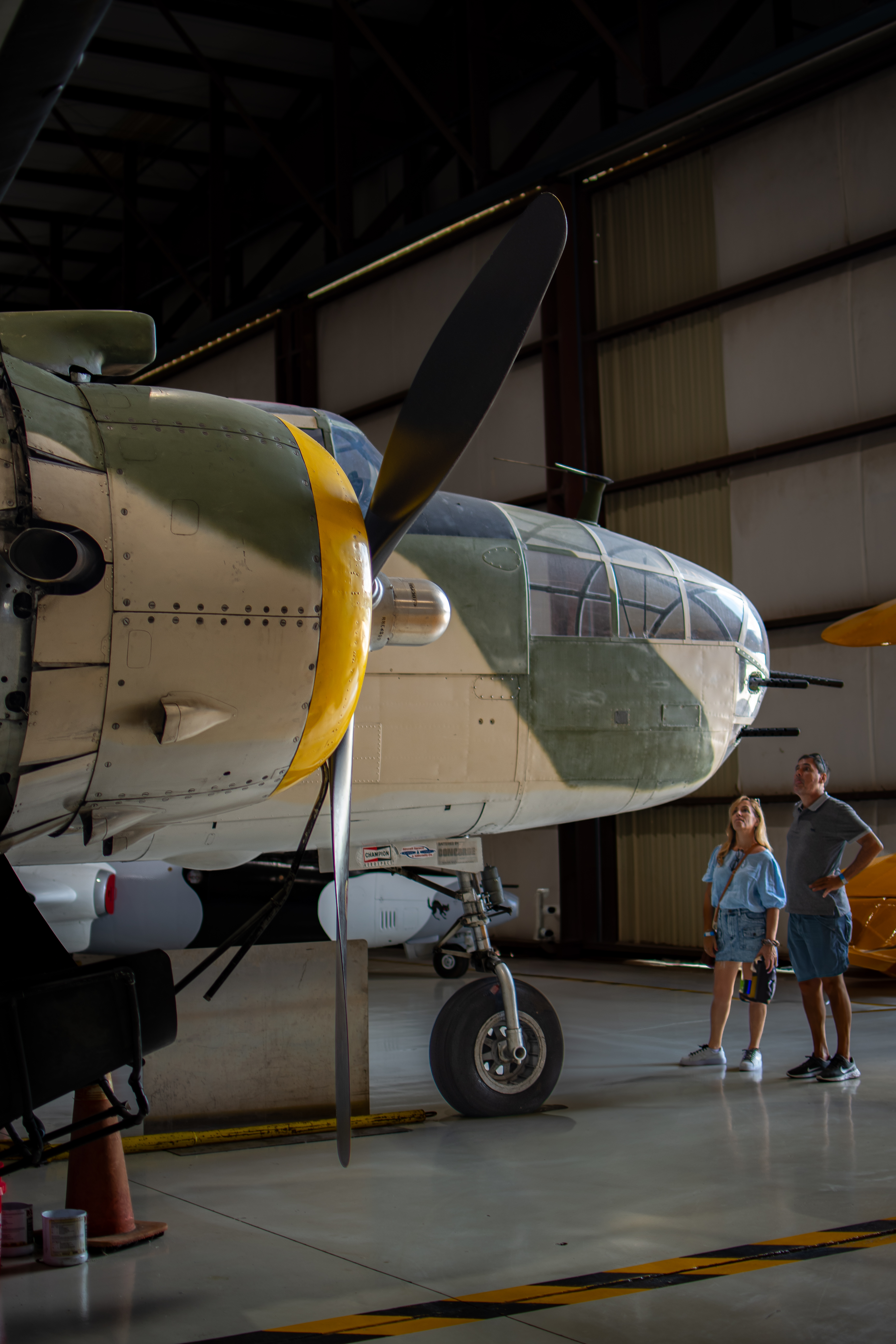
Meet the North American B-25 Mitchell "Killer B"
Serial Number - 44-86697
History
North American B-25 Mitchell "Killer B" - Serial: 44-86697
From Postwar Surplus to Three Air Forces and a Flying Warbird
The aircraft known today as “Killer B” is a North American B-25J-30-NC Mitchell, U.S. Army Air Forces serial number 44-86697, North American construction number 108-47451, and current civilian registration N62163.
Its history is unusual. Although built during World War II, 44-86697 was completed so late in the conflict that it never reached an American combat unit. Instead, it spent its early years in storage before beginning a long career that would take it through the United States, Canada and Venezuela, followed by more than two decades abandoned in the tropics and an extensive restoration back to flying condition.
June 1945 — The Last Months of World War II
44-86697 was manufactured at North American Aviation's Fairfax plant in Kansas City, Kansas.
North American test pilot James Malone conducted the aircraft's first test flight on June 12, 1945, flying for approximately 45 minutes. Malone flew it again the following day. The aircraft was completed on June 14 and delivered on June 15, 1945.
By then, the war in Europe had already ended and the United States possessed more military aircraft than it expected to require. Rather than being assigned to an operational bombardment group, 44-86697 was declared surplus to immediate military requirements.
This is an important part of its history: 44-86697 itself did not fly combat missions during World War II. The “Killer B” identity and combat-style markings it wears today were applied decades later during its restoration.
July 1945 — Smoky Hill Army Air Field
On July 22, 1945, only weeks after its delivery, 44-86697 was sent to Smoky Hill Army Air Field, Kansas, for storage.
On September 6, 1945, it moved to Independence Army Air Field, Missouri, where it was stored with the 4185th Base Unit.
The war against Japan had ended the previous month, and enormous numbers of aircraft were now being placed in reserve rather than entering operational service.
1947 — Pyote, Texas
On August 13, 1947, 44-86697 was transferred to Pyote Army Air Base, Texas, where it remained in storage with the 4141st Base Unit.
The aircraft consequently spent the first several years of its existence largely in reserve rather than accumulating the combat history normally associated with the B-25 Mitchell.
That changed in 1951.
1951 — Returned to Service
On October 18, 1951, 44-86697 was removed from long-term storage and sent to Brookley Air Force Base near Mobile, Alabama, for overhaul and maintenance.
Rather than returning to U.S. Air Force operational service, the aircraft was prepared for transfer to an American ally.
On January 17, 1952, records show the aircraft being transferred to the Royal Canadian Air Force. It was formally taken onto Canadian strength on January 24, 1952.
Royal Canadian Air Force — RCAF 5239
In Canadian service, former USAAF 44-86697 became:
RCAF 5239
The RCAF classified the aircraft as a Mitchell Mk. 3PT, part of a group of former American B-25Js acquired for training, experimental, administrative and support duties.
Its Canadian career would ultimately last approximately ten years and was considerably more active than its original American service.
1952 — Canadian Modifications and Experimental Work
On March 5, 1952, RCAF 5239 was placed in stored reserve at No. 25 Air Material Base.
On May 14, it was sent to North West Industries in Edmonton, Alberta, for modifications and a major inspection.
Then, on June 25, 1952, 5239 was assigned to the Central Experimental & Proving Establishment for use at the Canadian Armament Research Establishment at Valcartier, Quebec.
Some records suggest the aircraft may have been referred to as a Mitchell Mk. 3U while performing this work, although that designation may have been unofficial.
This represents one of the more interesting chapters of the aircraft's career: a B-25 originally built as a bomber was now supporting Canadian military research and experimental activities during the early Cold War.
1953 — Edmonton and Technical Support
On April 24, 1953, 5239 returned to North West Industries in Edmonton for additional modifications and a major inspection.
On July 15, the aircraft went back into storage at No. 25 Air Material Base. That same day it was assigned to No. 10 Technical Support Unit, with Canadian records describing the assignment as being for the purpose of studying or surveying maintenance problems.
1954 — No. 1 Advanced Flying School
On August 19, 1954, 5239 was transferred to Training Command for use by:
No. 1 Advanced Flying School
RCAF Station Saskatoon
Saskatchewan
The Mitchell was well suited to multi-engine training because its size and twin-engine configuration allowed crews to develop experience operating aircraft substantially more complex than the smaller trainers used earlier in their training.
1958 — Bristol Aerospace
On April 17, 1958, 5239 was sent to Bristol Aerospace in Winnipeg, Manitoba, for further modifications.
Following completion of this work, another significant training assignment followed.
1959 — No. 2 Air Observers School
On January 12, 1959, RCAF 5239 was assigned to:
No. 2 Air Observers School
RCAF Station Winnipeg
Manitoba
The school trained aircrew in specialized airborne duties. B-25s were used in connection with radar-intercept training, as well as administrative and utility work. Specialized Mitchells carried radar equipment while other B-25s could serve as airborne targets for interception exercises.
5239 continued serving in Canada until the early 1960s.
1961–1962 — Retirement from the RCAF
On September 21, 1961, the aircraft was transferred to inactive reserve at RCAF Station Lincoln Park, Alberta.
By November 23, 1961, it was awaiting disposal.
On April 10, 1962, the aircraft was sold to Columbus L. Woods / Woods Body Shop of Lewistown, Montana.
Its first American civilian registration became:
N92876
The RCAF formally struck 5239 from its records on May 23, 1962.
For the first time since being built in 1945, the Mitchell was now a civilian aircraft.
That status would not last long.
1963 — Return to Military Service
By August 1963, N92876 had been acquired by Bellomy Aviation of Miami, Florida.
Bellomy prepared the aircraft for sale to the:
Fuerza Aérea Venezolana — Venezuelan Air Force
The Mitchell was delivered to Venezuela in December 1963.
Its first Venezuelan military identity was:
FAV 11A40
and it was associated with No. 40 Squadron.
This gave 44-86697 the unusual distinction of serving under the markings of three different nations during its career: the United States, Canada and Venezuela.
Venezuelan Air Force Service
The former Canadian trainer was returned to a much more military-looking configuration after reaching Venezuela.
The aircraft was reportedly converted back to a glass-nose configuration, and side-mounted gun packs were added. Armor protection and other military equipment were also installed, although the upper gun turret was not restored.
Its Venezuelan serial was later changed from 11A40 to:
FAV 0953
The change appears to have occurred around 1967.
Unfortunately, surviving public records provide relatively little detail about its individual missions while serving with the Venezuelan Air Force.
What is known is that its active military career finally came to an end during the early 1970s.
1970s — Retirement at Maracay
Around 1972, FAV 0953 was withdrawn from service and placed in storage at Palo Negro Air Base near Maracay, Venezuela.
There it would remain for approximately twenty years.
The aircraft's condition deteriorated significantly during this period.
In 1975, the Bolivian Air Force acquired several operational B-25s from Venezuela. The Bolivians were reportedly also permitted to obtain parts from the remaining stored aircraft, including airframes such as 0953. Consequently, components were removed from the long-retired Mitchell during its years in storage.
By the late 1980s and early 1990s, the aircraft was a far cry from the airworthy Mitchell that had served Canada and Venezuela.
But it had survived.
1992 — Rescue from Venezuela
In July 1992, the abandoned Mitchell was purchased by Aztec Aviation Consulting of Miami, Florida.
In September, the aircraft passed to Steven A. Detch of Alpharetta, Georgia, and shortly afterward to Tricon Aero Corporation.
The aging bomber was dismantled in Venezuela, crated and transported back to the United States.
A new American civil registration was assigned:
N62163
What arrived back in the United States required substantially more than cosmetic work.
It would take several years of extensive restoration before the aircraft flew again.
1993–1995 — Restoration by Tom Reilly
Beginning in 1993, the Mitchell underwent a major restoration under Tom Reilly and Tom Reilly Vintage Aircraft at the Flying Tigers Warbird Restoration Museum in Kissimmee, Florida.
The restoration returned the former Venezuelan aircraft to an airworthy B-25J appearance.
After approximately two years of work, the Mitchell made its first post-restoration flight in August 1995.
It was during this restoration that the aircraft received the identity by which it is known today:
“Killer B”
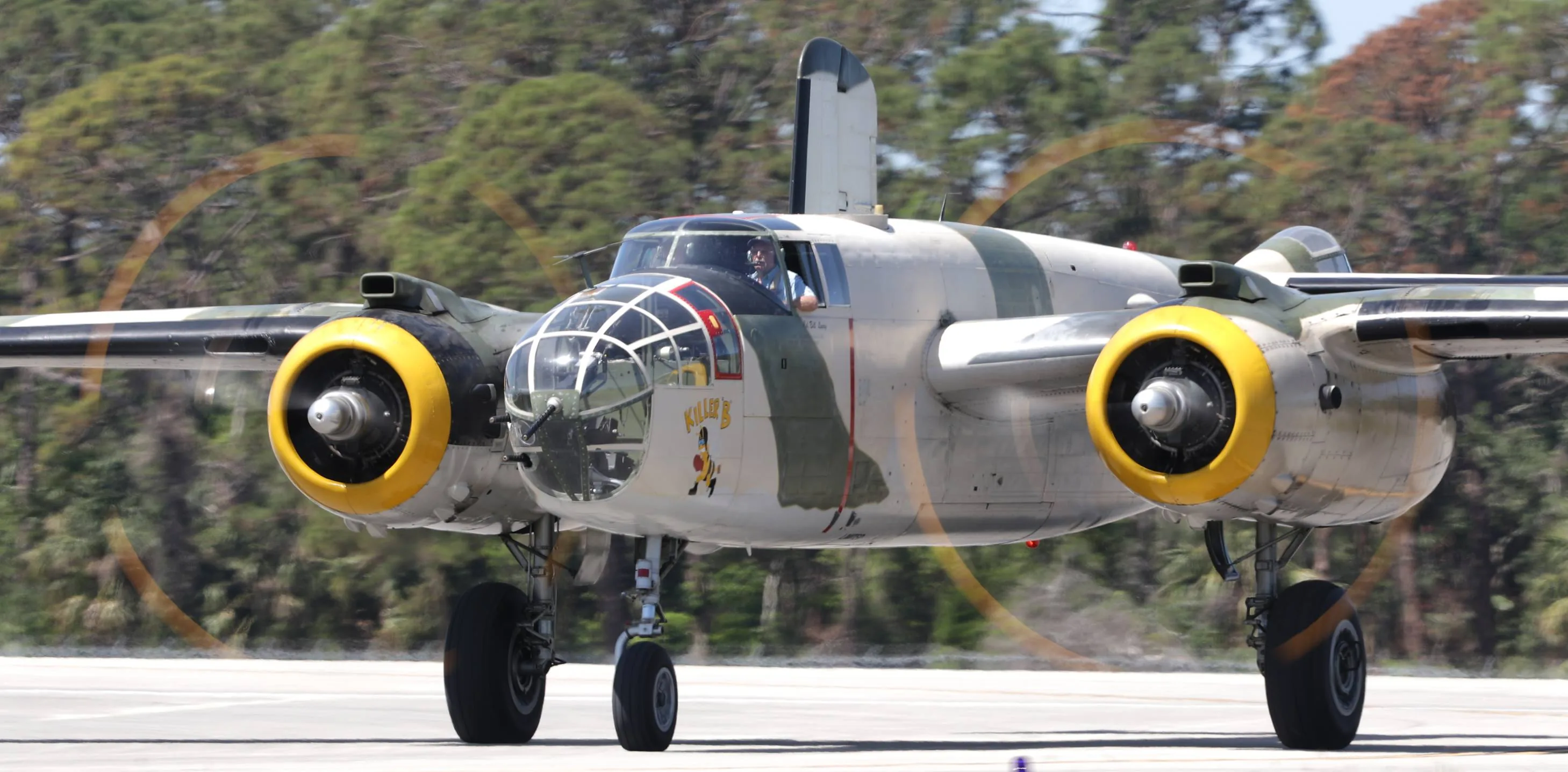
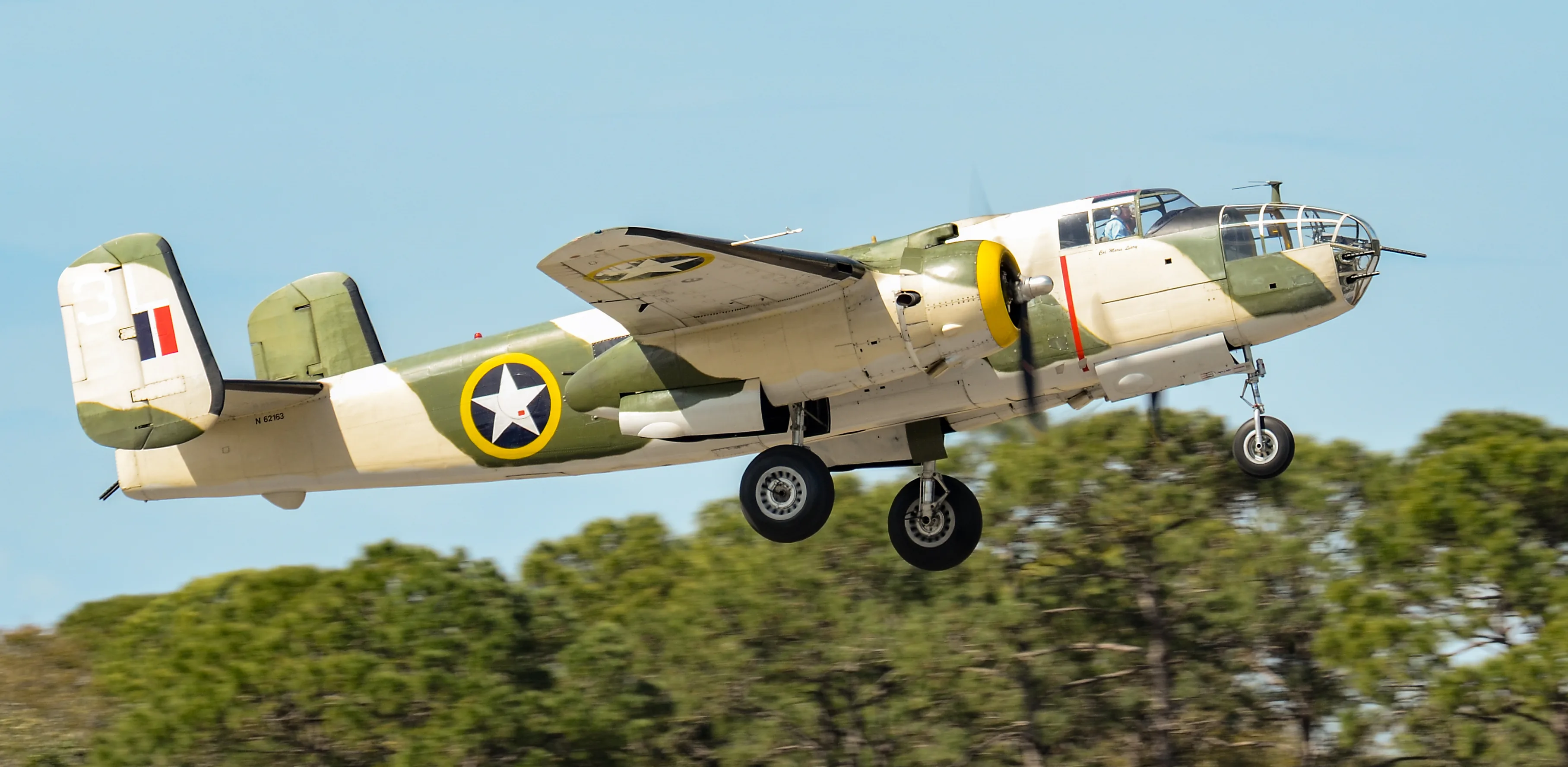
The aircraft was finished in a North Africa-inspired World War II camouflage scheme, with the code 3L, yellow-bordered U.S. national insignia reminiscent of markings used during Operation Torch, a British-style tail flash, and the distinctive Killer B nose art.
It is important historically to distinguish the appearance from the airframe's actual wartime service.
“Killer B” was not the aircraft's name during World War II, and 44-86697 did not see World War II combat. The markings honor the wartime B-25 and the aircraft's combat heritage as a type; they were applied during the 1990s restoration.
1996 — Back in the Air
The FAA issued an airworthiness certificate for N62163 on March 6, 1996.
The restored Mitchell subsequently appeared at airshows and aviation events around the United States, helping preserve the sight and sound of the B-25 for new generations.
Over the following years, Killer B was operated by Tom Reilly Vintage Aircraft, initially from Kissimmee and later from other locations.
Killer B and the Doolittle Raiders
Although 44-86697 itself was built too late to participate in World War II combat, Killer B has participated in events commemorating the B-25's most famous operation—the Doolittle Raid of April 18, 1942.
In April 2013, N62163 was among B-25s participating in a flyover connected with a gathering of surviving Doolittle Raiders at the Air Force Armament Museum near Eglin Air Force Base, Florida.
This allowed the aircraft to help honor the men whose daring carrier-launched raid made the B-25 Mitchell one of the most recognizable American aircraft of World War II.
Valiant Air Command
Killer B has been associated with the Valiant Air Command Warbird Museum in Titusville, Florida, for many years.
Photographic records document N62163 at the museum by at least 2010, and it has continued to be displayed and operated from the Space Coast. It has also participated in numerous airshows away from Titusville, demonstrating that it has remained an operational warbird rather than simply a static exhibit.
The aircraft is privately owned, rather than owned by Valiant Air Command.
More Than 80 Years of History
The history of 44-86697 is very different from that of a combat veteran, but no less remarkable.
Built during the closing weeks of World War II, it arrived too late to fight and spent its first years in storage. It was subsequently brought back to life for the Royal Canadian Air Force, where it served in experimental, technical-support and aircrew-training roles. It then returned briefly to civilian ownership before beginning another military career with the Venezuelan Air Force.
After retirement, it survived approximately two decades of outdoor storage in Venezuela, the removal of components for spare parts, and an uncertain future before being rescued and returned to the United States in 1992.
Following an extensive restoration, the aircraft flew again in 1995 as “Killer B.”
Today its identities tell the story of an extraordinary international career:
U.S. Military Serial: 44-86697
North American Construction Number: 108-47451
RCAF Serial: 5239
First U.S. Civil Registration: N92876
Venezuelan Air Force: 11A40 / 0953
Current Civil Registration: N62163
Current Name: Killer B
From a late-production bomber that never reached combat, to a Canadian Cold War trainer and experimental aircraft, a Venezuelan military Mitchell, a twenty-year storage survivor, and finally a restored American warbird, B-25J 44-86697 “Killer B” has survived more than eight decades and remains a flying reminder of one of the most famous medium bombers ever built.
TLDR; North American B-25J Mitchell “Killer B” — A Mitchell with an International Career
The North American B-25J Mitchell “Killer B,” serial 44-86697, was completed in June 1945, too late to see combat in World War II. After several years in storage, it was transferred to the Royal Canadian Air Force, where it served in experimental, technical-support, and training roles as RCAF 5239.
The aircraft later returned briefly to civilian ownership before serving with the Venezuelan Air Force as 11A40 and later 0953. After retirement, it spent roughly two decades stored in Venezuela before being rescued and returned to the United States in 1992. Following an extensive restoration, it flew again in 1995 as “Killer B.” Today, the privately owned aircraft operates as N62163 and remains a flying example of the famous B-25 Mitchell.
Gallery


bottom of page